
Vampires Will Never Hurt You (But This Review Might Sting a Little)
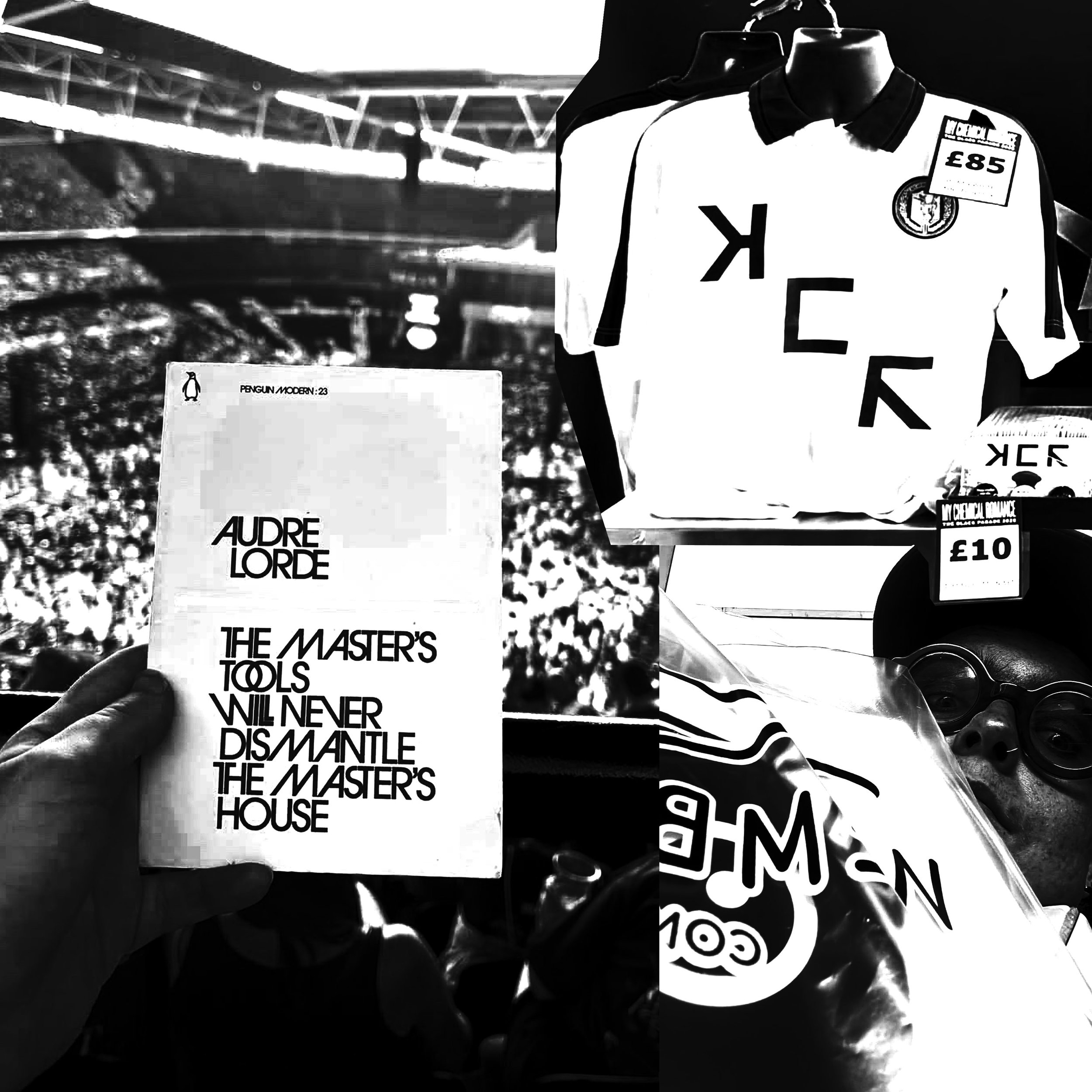
When I initially sat down to write this review, it’s fair to say that I hadn’t really given myself enough space to breathe in and swat away the stinkcloud of nostalgia that gave me pause in wanting to criticise My Chemical Romance’s Long Live The Black Parade tour. I’d started with a love letter, but that letter was quick to degrade and smudge as I considered the tour as a capitalist venture and not simply a performance of a record at a particularly large scale.
On Saturday the 11th of July, I sat alone inside the belly of Wembley Stadium, and I watched My Chemical Romance play through all of the Black Parade (amongst other hits and oddities) over the course of an evening. Like many people in the audience, it was a moment I’d been anticipating since I’d first heard the band almost a decade and a half ago.
I haven’t been obsessed with My Chemical Romance for a very long time. The departure I made from my interest in emo and emo-adjacent music was a move of self-preservation and a fickle display of teenage whims, but from the ages of 12 to about 15, I moved through the world in a daze of angst and pity, supported and comforted by those early MCR records. They weren’t my first favourite band, no, but they were the first band that restitched my core and altered the way I would exist on this planet from then on. A lot of people can say that, really, as evidenced by Wembley’s almost-full rafters.
I’m in a group of MCR fans that started listening to the band shortly after they’d released their last canonic album; Danger Days (15 years ago, in accordance with all of the promotional material and merchandise they’ve been dropping to celebrate its anniversary), which means that I was also present for the devastating news that they’d broken up in 2013. I’d missed their initial reunion tour in 2022, but managed to secure tickets via a pair of my oldest friends who’d bought as many tickets as they could when this show had initially gone on sale. This was my first time seeing them, and it was always going to have been a big deal for me.
Something I couldn’t help but think about as I moved through a sea of folks dressed in red and black was; were this many people always into MCR? Enough folks to pack out a 75,000+ venue for 3 days? When I was a teenager, there were only a select number of my school peers who knew the band, and I was friends with the majority of those peers. It was a connective tissue we all shared, something that would create a tenuous link if it was any other band, but MCR were more of a doctrine, a way to live and make sense of your life. It’s easy to adopt an us VS them sentiment about it, too. I’d assumed at the time that if you weren’t into emo music, your instinct was to bully those of us who were, but it’s not that simple because there aren’t two singular categories that every single human fits into. It’d be very easy to pick who to avoid if that were the case.
I think when something is so deeply personal to you, it’s hard not to feel protective over the sanctity of it. There’s a part of me that does not believe that every single body in that room understood the lyrics and themes in each and every MCR song as deeply as I did (or still do, judging by the visceral reactions that I was having during the show). I know that I’m getting dangerously close to crying ‘poser’ here, but why did I feel so lonely as a teenager if there were so many other people also listening and feeling?
The simple explanation could be that people came from all over the country and all over Europe to see MCR play Wembley Stadium, on account of the select dates for the tour. The other explanation is that this isn’t really music for the counter-culture anymore. Maybe it hasn’t been for a long time.
I saw and spoke to all sorts of people at the gig; hysterical girls with graphic liner, stoic men sporting tightly clipped hair and crossed arms, and maybe my favourite? A gaggle of middle aged women from Middlesborough, (dressed more for an evening at the pub to watch the football rather than a band most famous in the UK for inciting suicide cult accusations by The Daily Mail), one of which was misinformed about the band that she’d be seeing and had been listening to The Chemical Brothers all week in anticipation.
I should probably get to the meat of the concert, really. This tour was in celebration of the 20th anniversary (again with the anniversaries!) of their seminal rock opera The Black Parade, a concept record that deals with the oncoming death of a terminal cancer patient. My Chemical Romance have always had a theatrical lilt, and The Black Parade was the natural culmination of those tendencies, complete with mighty choruses, genuine sing-along hits (thinking of Teenagers and the eponymous Welcome to the Black Parade), and even a Liza Minnelli feature that remains one of my favourite oddities on any record, ever. It’s an album that takes itself very seriously. There’s pockets of humour, sure, and that humour is exacerbated on this tour (more on that later), but The Black Parade is about death and the consequences of illness on both the individual and the family. It’s an album that has had a lot of reappraisal in the years after its initial release (including spots on Rolling Stone’s ‘Most Influential Albums of the Century’ list and a review by Anthony Fantano as part of his Classics series in spite of his proclivity for emo based snobbery), and while it’s not my favourite record from MCR’s back catalogue, it remains a ballsy and impressive kick in the teeth that situated them closer to a band like Queen than Linkin Park.
A personal bugbear of mine is that I intensely dislike having to understand things in order to have a good time. I struggle with bands that craft copious amounts of lore and backstory that you have to have some sort of grasp on to make sense of the music. You won’t catch me gathering data and ideas or creating a conspiracy string-board in an attempt to make something out of nothing. I think this is probably fun for the majority of fans, but I find it to be a barrier of entry.
MCR were never going to simply tour The Black Parade 20 years after its initial inception without some sort of marvellous gimmickry to keep it interesting for fans and the band alike. As mentioned, they’ve always had a penchant for dramatics, so learning that this tour has an overarching story, concept and theme was not surprising for me, but I did find it to be laborious.
Without boring you (or myself) too much with the details, the tour’s concept is that the band are (unwillingly) playing a show for the leader of the fictional fascist state of DRAAG, a country with a language that has an eerily Cyrillic style alphabet, and it’s a show that they’ve been tasked with performing again and again. There’s a secretary, some sort of government official, and a live ‘execution’ where the audience are given cards to aid in a vote (YEA on one side and NAY on the other). There’s obvious allusions to both the Soviet Union and North Korea, complete with custom footage shown on the giant screens that depicts nuclear families and couples smiling and sharing wheat (which I believe Gerard Way is seen consuming somewhere during the show’s latter half), plenty of farming imagery and other faked propaganda. Whether the band are riffing on late-stage American capitalism or the failures of communism? You can step out of your seat, into the main hall of Wembley and purchase a £50 T-Shirt, so maybe it’s not that effective as commentary.
From those things alone, we’ve touched on capital punishment, we’ve touched on food-scarcity, and we’ve touched on propaganda. The bows are all very obvious and neat if you’ve ever sat in a high school history class outside of the United States.
Here’s my first gripe; it’s very hard to follow this storyline from the cheap seats. In my sky-high £53 seat, visibility is limited. Sure, there are giant LED screens that are meant to capture the action on stage, but because I was so high up, even those screens were difficult to follow. I couldn’t really make out where the band actually were, and there were details I missed that I wouldn’t notice until seeing pictures of them on Instagram later that week (Gerard’s plastic mask was not something that I picked up on from those LED screens, for example).
My second gripe; how effective is framing yourself as the proletariat on a comeback tour that, while emotional and nostalgic for many, is an easy way to earn a boatload of retirement money? It sort of frames us as the bourgeoisie, which doesn’t sit right with me. MCR played three nights at Wembley overall, with tickets for the front pitch going from between £100-£141 before resale, I’m not saying that a stadium band isn't allowed to commentate on the state of the world, but there’s some irony to be read between the spectacle, especially when I had such a hard time making sense as to what exactly was going on from my (as previously mentioned) cheap seats.
The show-pieces are not as effective from far away as they must have been up close. You don’t feel the scalding heat from the pyrotechnics, and you only catch a mere glimpse of a man set on fire during ‘Mama’. It’s difficult to tell where everyone is on stage from the back of the stadium, especially when your eyesight immediately wants to follow the LED screens in hopes of stringing the show together.
I also take mild umbrage with the showing vs telling approach to the political commentary presented here. While I want to be satisfied enough with reading between the lines of what they’re trying to communicate via the fictional state of DRAAG, maybe metaphor just isn’t strong enough of an explainer anymore. I want more than just metaphors. I want to know why your heart is bleeding, why they’ve decided to parody a dictatorship throughout this tour and the better part of two years.
“If ripping off The Wall (the academic in me wants to tell you that The Wall is Pink Floyd’s seminal and overtly political rock opera from 1979, but you probably already knew that) was a crime, then send everyone to jail.” said my friend Thom, as I explained to him the tour’s watery criticism of authoritarianism and the world at large, and he’s right. Like many spectacles before it, including The Wall, Long Live The Black Parade is interested in exploring art beneath a force that you have no choice but to obey. It’s a popular vessel of leftist ideology used by rock bands both modern and classic. I read a collection of other reviews from a series of Large Publications, and the majority of the press was glowing, enamoured by the effort and the big old swing that was taken to keep the material fresh, modern, and timeless. This isn’t the first time that I’ve ever felt like a big spoilsport, a cynical naysayer. Many of the reviews aren’t that interested in touching on the lore, though. Other writers treat it like a preposterous and almost novel addition to a wildly theatrical stage show. The NME even went as far as to say “There’s a lot of lore that goes into the dystopian world-building at play in the show’s first half, which almost feels better left unexplained.”
It’s barely regarded as something to write home about, a stupid hat that tops off an outfit that didn’t need it in the first place. Maybe I’m coming into this with too much contention, but I don’t go to my stadium bands for satire. I don’t really go to stadium bands at all, but the one time I do? I’m left squinting at a stage, waiting for the crowd to indicate as to whether I should laugh or gasp or cry. Apparently there’s a ventriloquist's dummy on stage during Cancer. I couldn’t see that, and maybe I’m bitter about the access that is taken away when you’re forced to pay less, but couldn’t some of these details have been made slightly clearer? The concept of Gerard Way singing the album’s emotional core to a literal fucking dummy is hilarious and dissonant enough to actually work. Not that I saw it.
Maybe there’s a reality in which I understood every detail and I loved it, couldn’t get enough of the ‘madcap’ nature. Maybe that reality came with a press pass, or access to better seats through some sort of monetary difference in my life.
I am aware that this is not a popular opinion. Again, the majority of reviews that I read after seeing the concert fawned over the concepts presented, the reframing of The Black Parade’s story. I’m willing to accept that I’m being too touchy, hypercritical, but I think it’s important to consider the podiums that artists are standing on when they make grand statements. It’s like if Christopher Nolan had made Parasite or something. When I’m living paycheck to paycheck, cutting the mould off of my vegetables because there’s nothing else in the fridge to eat, do I really want to squint down at my nostalgiafest and think about immolation, starvation, and indoctrination as told by a gaggle of successful artists on a homerun tour?
The B stage set was really fun. This was the second set that MCR played after performing all of The Black parade, no costumes or Tour Lore in sight. They played Vampires Will Never hurt you and I hurt my throat from screaming so loudly that I thought I was sick for the next 4 days after that. I’m not immune to nostalgia, but maybe I was just looking for a bit more escapism inside of it.
Newt Albiston is a music and culture writer, and one half of Keyring Records (your favourite mobile vinyl shop). You can find more of his work via their linktree, and can check out Keyring Records on their discogs.